

My academic research project focuses on expanding the understanding of Bombus griseocollis population genetics using RADSeq and WGS, while extracting DNA with minimum tissue through a non-lethal collection method. Over the past year, I have extracted flight muscle from the thoraxes of bees and utilized PCR, gel electrophoresis, and Ugene software to analyze concentration and similarity.
This past summer, I adapted methods used in the study (Mola et al., 2021) that used tarsal clippings of bees for DNA instead of killing and freezing the entire bee. This resulted in a smaller yield of DNA to work with, but still produced a viable amount. This will allow me to potentially continue this project with an endangered species or population without it being lethal. I tested this method on bees currently in the lab to find the amount of tissue needed for quantifiable results, and then I plan to proceed to a new population. In addition, B. griseocollis has not had a published whole genome, and my project may eventually lead to the publication of this species’ whole genome sequence which can provide reference for other researchers.

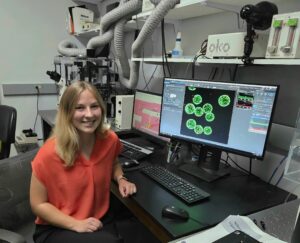 This project aligns with the NASA Mission Directorates by addressing a physiological risk that affects human safety and performance during spaceflight. Space exploration is an important endeavor, but it can only be sustained if we uphold the health and safety of astronauts. By advancing our understanding of cellular responses to microgravity, this research will provide insight into countermeasures that support astronaut health and performance.
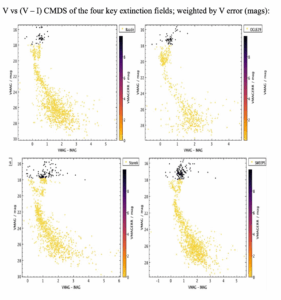 In this project, I revisit “low extinction windows” in the Galactic Bulge previously studied by Thomas Brown (2009) via the WFC3 Galactic Bulge Treasury Program. I will compare the results of the program’s Hubble Space Telescope’s WFC3 data to newer data by cross matching it to databases such as Gaia’s EDR3. Additionally, we will use new stellar models such as Tim Morton’s isochrones (2015) and explore more recent studies of the Bulge if time permits. From this, I will create improved extinction maps to characterize the stellar populations of the Bulge. All of this will provide a deeper insight into the kinematics, composition, and evolution of both the Galactic Bulge and the Milky Way.
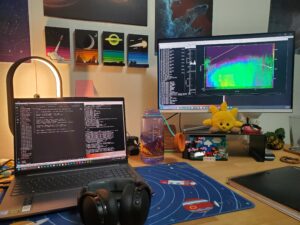 Eugene Parker first coined the existence of a “solar wind” in 1958, theorizing that the Sun’s corona emits a constant stream of charged particles as a plasma. Since then, heliophysicists have been working to describe the mechanisms, phenomena, and structures that occur due to the solar wind.


 ortation technologies and urban planning practices by developing machine learning frameworks that prioritize both operational safety and accessibility in UAM system design.