

 This project aims to extend strain-based kinematic shape sensing from 1-D beams to 2-D plates.
Kinematic shape sensing methods use discrete measurements of strain to infer structural deformations using purely geometric/kinematic models. This is computationally efficient, independent of structural material properties, and extremely accurate when applied to certain geometries. Previous efforts have focused upon the deformations of long, slender, beam-like bodies, which were dubbed “shape-sensing spars”. These spars were used as sensors by inserting them into flexible wings to track deformations and perform novel fluid-structure interaction experiments. A next step in novel shape sensing would be to extend the instrumentation from beam-like structures to 2-dimensional plates, which would allow structures like ship hulls, tank walls, or airplane fuselage panels to be monitored with unprecedented rigor.
This research focuses on extending a kinematic reconstruction algorithm to 2D applications and investigating optimal sensor placement and produce a prototype of an instrumented panel. Experiments will be performed to validate the kinematic reconstruction of both static and dynamic deformations imposed on the plate with known boundary conditions.


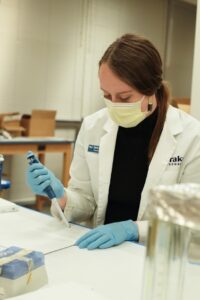 Radiation-induced DNA damage demands recognition as the ultimate insult to cosmonauts’ genetic material. Recently, we have identified a novel nuclear matrix metalloprotease (nMMP) activity possibly associated with DNA repair related to ‘Sample M’. In an effort to improve upon Sample M, we describe the optimization of nanoparticle encapsulation for the purified sample known as Compound MP. Nanoparticles are widely known drug delivery systems for improving pon a compound’s stability and allowing for widened functionality (de Alcantara Lemos et al., 2021). As a comparative measure, this protocol will be examined with existing commercial pharmaceutical agents Epinephrine and Nifedipine. Upon successful nanoparticle encapsulation, Compound MP will be examined further for relative DNA repair functionality.
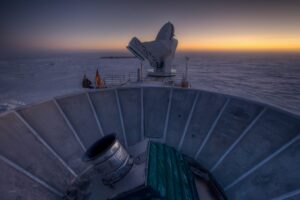 The latest cosmologies predict inflation in the early universe to have imprinted a signature polarization pattern in the cosmic microwave background (CMB). The BICEP/Keck Array is a collection of telescopes that aim to detect this unique pattern and constrain inflationary models. Precision measurements of the CMB require a thorough understanding of instrumental systematics. Determining the differential beam between pairs of orthogonal detectors is essential to mitigating the effects of temperature-to-polarization leakage, a significant source of systematic error. The first step in characterizing the beams is the demodulation of a signal from observing a chopped source. Here we summarize previously implemented demodulation techniques and propose new methodologies. We will further benchmark and compare the performance of each demodulator on simulated calibration time-streams and the latest data from the BICEP/Keck Array experiments. We find that a Fourier-space deconvolutional approach was most successful at accurately characterizing the beam, improving our understanding of the instrument to mitigate the effects of temperature-to-polarization leakage. With this information, we intend to continue developing this new approach for eventual implementation into the final science analysis pipeline.
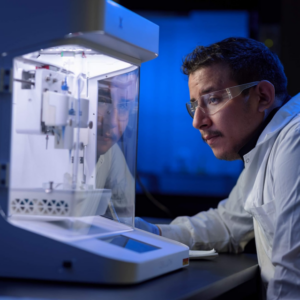 Graphene is a 2D sheet of carbon atoms with diverse chemical and physical properties, such as high electrical conductivity and mechanical strength, that is suitable for large-scale production. This material has been widely studied over the past decade and is commonly used for the development of electrochemical sensors, such as ion-selective electrodes (ISEs), which measure the activity of an ion in a solution. Current ISEs are designed for the detection of different ions in biochemical and biophysical research. However, these ISEs suffer from low signal-to-noise ratio and poor long-term stability, making it difficult to apply in complex matrices like food, soil, and water.
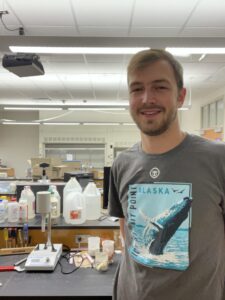 One of the many challenges that face any extraterrestrial mission is the need for high strength while maintaining a low weight during transport to reduce cost. Our academic research consists of creating materials with high strength-to-weight ratio from nanocellulose for extraterrestrial applications. Nanocellulose can be synthesized from cellulose, which is the most common organic polymer found in nature. Nanocellulose is synthesized by applying ultrasonic agitation to a mixture of purified cellulose in water. The result is a very viscous suspension of nanocellulose and water which is dried to form solids. These solids have a strength-to-weight ratio 8 times greater than steel while also remaining stiff. The main problem with making nanocellulose solids is the inability to control the shape of the solid being created and the abundance of cracks and impurities running throughout the solid which reduces the strength. The research currently involves combining nanocellulose of varying sizes, from 1 nanometer to 1 micron, to create a composite which, upon drying, has a lower density while still maintaining strength. During the drying process a nanocellulose suspension will lose 90% of the water, but when combining differing sizes of nanocellulose, volume loss is cut down to 20% which reduces strain on the material when drying leading to less cracking and better shape retention. The solids created are machinable and suitable for building structures. Using nanocellulose for planetary missions would negate the need for bringing building materials, reducing weight and thus reducing fuel needed for transport.
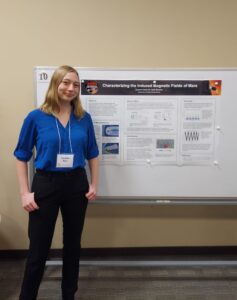 When charged particles from the solar wind interact with a planet’s atmosphere it induces a magnetic field. This research project aims to study this phenomenon at Mars and compare it to prior data from Venus to examine how planet-specific properties affect the interaction.
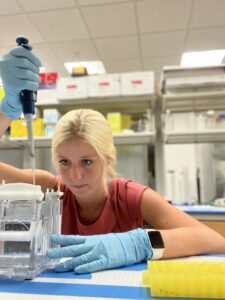 Exposure to radiation causes double-stranded breaks (DSBs) in human DNA, leading to many types of cancers. Humans are at risk of radiation exposure through medical examinations, treatments, nuclear accidents, and space travel. Thus, investigating the effects of radiation-induced DNA damage is important for finding new ways to protect humans from radiation-induced disorders. Last year, I investigated the effects of DSBs on B-Raf, an important signaling protein involved in cell growth and DNA repair pathways using human cancer cells as models. These cells were treated with doxorubicin, a radiomimetic drug (a compound that mimics radiation and creates DSBs in cells).
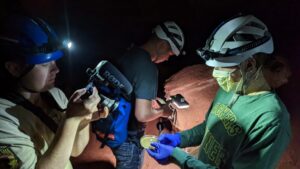 Samples were collected at Wind Cave National Park on multiple different trips. As the team goes deeper and deeper into the cave, the goal is to actively trace the types of microorganisms (fungi, bacteria, and archaea) throughout the cave. The process to obtain genus- and species-level identification of these samples utilizes PCR amplification of different sections of their genomic DNA followed by sequencing analysis. The objective of this project is to make a genetic map of the Wind Cave microbial system that includes public tour routes as well as deep wild cave regions, including previously reported lake extremophiles. This effort will determine how genetically unique or isolated the lake system is and what influence surface microbes and anthropogenic contamination from cave explorers may have had on the subterranean microbiome. An initial phylogenetic tree showing the relatedness of the identified microorganisms is presented. This project is based upon work supported by the Iowa Space Grant Consortium under NASA Award No. 80NSSC20M0107.
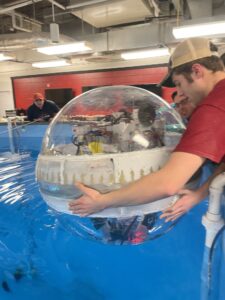 Upon deployment, small satellites can fail to satisfy mission objectives due to the lack of affordable testing equipment for attitude determination and control. The Floating Attitude Control Test System project, known formally as FACTS, Aims to reduce the failure rates of small sat failure upon deployment by providing sub-system level verification for CubeSats. The current FACTS platform can fit up to a 3U size CubeSat and features scalability. The system allows for the center of mass compensation and currently offers three degrees of rotational freedom. The system is currently being improved by verifying system dynamics using a Qualisys motion tracking system to analyze quaternions and spatial rotation to provide useful test documentation. The future for FACTS is to distribute the system as an open-source platform for smaller educators and universities for CubeSat testing and expand the system to fully test attitude control in six degrees of freedom.