

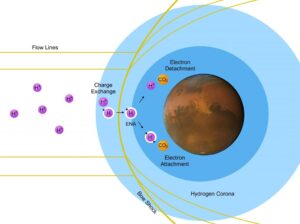
 This research project focuses on how the solar wind interacts with the Martian atmosphere. As solar wind protons propagate towards Mars, they can interact with Mars’s extensive hydrogen corona through a process of charge exchange. These solar wind protons can obtain an electron from neutral atomic hydrogen in the corona, becoming fast energetic neutral atoms (ENAs) that maintain upstream solar wind velocity. These ENAs can bypass electromagnetic boundaries around the planet and penetrate to altitudes of ~130 km in the Martian atmosphere. Along their path of propagation, ENAs can undergo multiple charge-changing collisions as they interact with atmospheric neutrals (primarily CO2), resulting in observable beams of H+ and H– in the collisional atmosphere of Mars. The goal of this project is to characterize the properties of H– and H+ energy spectra in order to better understand charge exchange processes in the Martian atmosphere.
Thus far, we have implemented electron and ion data collected over seven years by the Solar Wind Electron Analyzer (SWEA) and Solar Wind Ion Analyzer (SWIA) onboard the Mars Atmosphere and Volatile EvolutioN (MAVEN) spacecraft and have found some interesting behaviors. We have observed seasonal increases in the H+ and H– fluxes congruent with perihelion and Mars’s dust season, in addition to a turnover in the ratio of the H+ and H– fluxes at a particular point within Mars’s atmosphere. We have also found that this seasonal enhancement is stronger for H+ and are seeking to better understand the underlying cause of this behavior by examining hydrogen column densities, solar radiation input, and bow shock position.


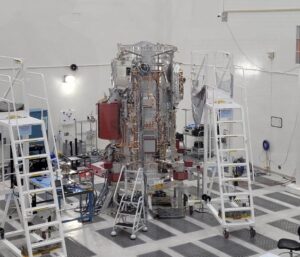 This project is a continuation of my summer 2022 internship experience at the Jet Propulsion Laboratory, made possible by the JPL Visiting Student Research Program (JVSRP). Mentored by Dr. Hannes Kraus and Dr. Corey Cochrane at JPL and my advisor, Dr. Michael Flatté, I developed a preliminary model of OPuS-MAGNM, a cutting-edge optically pumped magnetometer which uses the spin of a single silicon vacancy (VSi) in silicon carbide (SiC) as a quantum sensor of magnetic fields, using density matrix formalism and Lindblad master equations. In addition to fuel conservation, the inexpensive and simple mechanism of OPuS-MAGNM is advantageous over its state-of-the-art but expensive, optically pumped contemporaries, whose chambers of atomic gas inevitably leak.

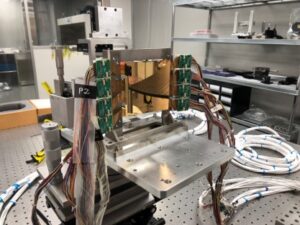 X-ray telescopes are critical for studying a myriad of high-energy sources: black holes, hot plasma surrounding galaxies, and the atmospheres of stars. Given this, the 2020 Decadal Survey on Astronomy and Astrophysics, which guides the science priorities of NASA’s Astrophysics Division, recommended an X-ray flagship mission for launch in the 2040’s. However, the Astrophysics Division’s Biennial Technology Report identified X-ray mirrors needed for such a mission as a Tier 1 (“highest priority”) technology gap.
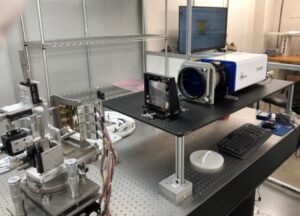 Current methods of X-ray mirror fabrication create significant figure distortion and degrade mirror performance. My research project will contribute to the maturation of two adjustable X-ray optic technologies aimed at closing this technology gap. Both concepts will use thin-film piezoelectric actuators deposited on the back of a mirror. When supplied a voltage, these actuators bend the mirror’s shape locally. Utilizing an array of actuator cells across the mirror’s surface, we can induce more complex figure changes. With high precision optical metrology, we can measure and apply a deterministic figure correction to the mirror, increasing its angular resolution. The first technology uses lead zirconate titanate (PZT) for the piezoelectric material, while the second concept will use electroactive polymers. Electroactive polymers can be processed at lower temperatures than PZT, making X-ray mirrors less susceptible to deformation from thermal stress. However, electroactive polymer actuators are currently at a lower technology readiness level than PZT. High precision metrology will be used to characterize not only the dynamic range of these technologies, but ultimately their performance at figure correction.
 My research project focuses on the synthesis, structural evaluation, and property optimization of glassy solid electrolytes for their use in all solid-state batteries (SSB). My objective is to create a SSB that is safer than their liquid electrolyte counterparts that can be used for space or vehicular technologies. More explicitly, my project explores the development of a new class of Glassy Solid Electrolytes (GSEs), a mixed oxy-sulfide-nitride (MOSN), which has the potential to overcome the conductivity, cost, and stability disadvantages of current solid electrolytes (SEs) needed for an all SSB. This unique class of materials exhibits high ionic conductivities of the sulfide glasses, improved chemical stability due to the inclusion of oxide glasses, and improved electrochemical stability when in contact with lithium metal because of the addition of oxy-nitride glasses. I hope to find an electrolyte that can be easily synthesized, optimized, and then placed into a SSB design to test the capabilities of these electrolytes.

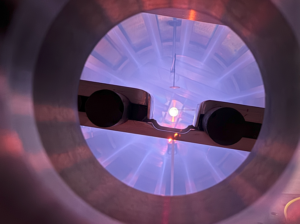 Characterizing plasma-wave interactions is critical to understanding particle energization mechanisms in space plasma environments and in applied technical fields. Currently, there is no conventional scattering theory for waves in plasma physics. Our research project is focused on the study of waves interacting with plasma ions trapped in a dipole magnetic field. Charged particles in a dipole field undergo a range of periodic and chaotic orbits, providing a general particle trajectory as a test bed for plasma wave scattering. Laser-induced fluorescence (LIF) techniques allow measurement of incident and reflected wave coefficients of ion acoustic waves launched toward the trapped plasma, allowing comparison to models being developed for describing the physics of these plasma wave interactions. Using LIF, we plan to describe approaching and trapped ion behavior as a function of velocity, as well as the incident and reflected wave interactions with the ions. Initial Langmuir Probe measurements have been made to describe the plasma conditions in and around the dipole magnet, and to measure the wave-induced variations in particle flux as a function of time and distance from the magnet.
