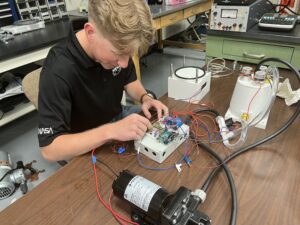
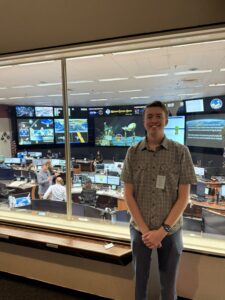
Matthew Staber- Johnson Space Center

Accomplishments:

I developed new Isotonic mode firmware for the PKD (knee dynamometer), enabling astronaut strength training and rehabilitation at torques up to 240 ft-lb. I also contributed to ARC-ANGEL, a wearable system simulating lunar and Martian gravity, by building software and middleware for ODrive motor controllers, supporting the successful Test Readiness Review (TRR) and prototype deployment. Additionally, I assisted in the mechanical design of the UPRITE rack, a proprioception-training device, focusing on safe shell integration for astronaut use. I collaborate daily in a team of four interns and six mentors, integrating hardware, software, and firmware solutions across projects. Beyond project work, I engage with over 130 interns through the PIPE/SCuM professional groups, where I help organize events and participate in intern rocketry.

Mid-term Goals:

I plan to continue advancing the ARC-ANGEL system, improving performance and reliability of the ODrive control software gui, and supporting upcoming testing in NASA’s ARGOS offload facility. I also hope to refine the isotonic mode firmware for the PKD to further enhance astronaut training capabilities and to contribute to system-level integration across the hardware and software teams.

Impact:

This internship has been one of the most amazing experiences of my life. I’ve learned so much from incredibly talented mentors and peers. The intern community, both professionally and socially, has been inspiring and supportive, and I’ve built connections that I truly value. This experience has strengthened my passion for STEM and for NASA’s mission!I hope everyone has the opportunity to work in an environment like this someday, whether in STEM or Non-STEM, because it’s been wonderful.

Adam Rutecki – Collins Aerospace

Describe what you did during your internship:

Throughout this internship, I was able to get hands-on experience performing first unit integration and testing of software-defined radios and high-power radio amplifiers. This allowed me to gain many insights into intentional design decisions that are made for space environments and interfaces between hardware, firmware, and software and their integration. Throughout this, I significantly deepened my understanding of Python by writing automated tests, firmware interfaces, and testing user interfaces. I also have significantly expanded my knowledge of secure RF communication theory and digital signal processing through mentoring sessions with engineers and on-the-job learning resources provided by Collins. Lastly, I was able to assist with requirements traceability work and test procedure development, giving me a valuable insight into this important work that ensures customers receive working hardware to fulfill their missions.

Did you achieve your goals?

In summary, this internship provided useful and insightful experience that will prove valuable in understanding and continuing to work on applications of terrestrial technology to space. The experience has also connected me with many great mentors and leaders, and will prove useful in helping me secure a full-time job before graduating in the spring of 2026.

Describe positive lessons learned:

One of the most valuable lessons I took away from this summer was the importance of prioritizing learning and professional development to deepen my understanding, as well as seeking out strong mentors to support my growth as both an engineer and a leader.

Describe negative lessons learned:

I did not realize the importance of advocating for my interests in an internship program that offered flexibility in terms of the types of work I could do.

What was the impact of this internship?

Being a part of this team has given insight into how crucial of a role solutions for space can play, and how commercial solutions can be quickly adapted for low earth orbit applications.

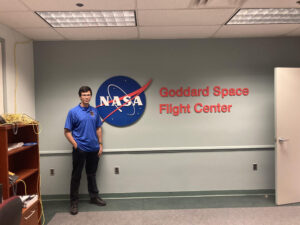
Ryan Muetzel – Goddard Space Flight Center

Describe what you did during your internship:
I had two tasks in the internship. The first was to familiarize myself with MagicDraw MBSE modeling. To do so, I was given a training project to learn the systems, so I could later build tools that would integrate with MagicDraw development. During the training project, the design decisions were also intended to be used an example training guide for future systems engineers. The second task was to develop a tool for test plan creation. The goal was to create a series of AI agents that would take functional requirements, create test plans for each requirement, and then consolidate test plans where they overlap to increase testing efficiency. These test plans would still need to be reviewed by professional system engineers, but this tool was designed to bootstrap the initial phases of systems engineering and skip a lot of the initial work typically incurred at the start of a project.

Did you achieve your goals?

Both projects went really well. The training model was completed quickly, and I learned a lot to help me in the second task. This basically taught me the process for completing the three tasks listed in the project goal, which I leveraged to improve development of the test plan processing software. The final output from the second task was successful, and I created a proof of concept system that was able to process the majority of requirements into usable test plans for systems engineering development. The solution is not yet perfect and there are a handful of issues that need to be handled in the future. However, the final program that I had created lays the groundwork for future development to revolutionize how systems engineering work is done.

Describe positive lessons learned:

I learned a lot during this experience. I took a deep dive into learning how systems engineering development works, especially at the onset of a project. This was also my first experience working with an AI agent for a dedicated task. Training and tuning the AI’s output was certainly a learning experience, and taught me a lot about what they can and cannot be used for.

Describe negative lessons learned:

I think the main negative lesson I learned is that there may not always be a solution, at least with the current mindset. Looking at a problem or architecture from a different perspective can reveal the real issue or at least provide insights into the issue at hand. A mindset change, based on a new perspective, may reveal that the current idea is not feasible and requires a new approach. This was a painful lesson for me to learn, when I realized I needed to rebuild my architecture for the second project, but making that change and rebuilding let me make a successful final solution.

What was the impact of this internship?

This internship has shown me how software and AI can be used to solve real-world engineering problems, especially in space missions where reliability is critical. It’s made me more interested in working on tools that support large, complex engineering projects.

Gabe Holden – Marshall Space Flight Center

Describe what you did during your internship:

During my internship with ER-63, I focused on supporting the development of accurate models and control methods for a BLDC motor applied to an inertial load simulator. I researched and implemented data acquisition methods using a Magtrol DSP7001 controller paired with an HD-715 dynamometer, enabling precise measurement of motor behavior. Using LabVIEW and MATLAB, I derived key motor parameters including rotor inertia, viscous friction, and Coulomb friction, which supported the building high-fidelity Simulink models. I also supported deploying field-oriented control (FOC) on the BLDC motor through the Arduino SimpleFOC library, allowing for improved torque control and motor efficiency. Additionally, I designed and tested a physics-based soft-stop safety feature in Simulink and created a quick-start guide to streamline future use of the inertial load simulator.

Did you achieve your goals?

All of my objectives were completed over the course of the internship. I established reliable DAQ methods, extracted accurate motor parameters, and implemented FOC, supporting the creation of validated Simulink models and improved motor control. These outcomes advanced ER-63’s testing capabilities and provided practical tools for future users.

Describe positive lessons learned:

My favorite part of being with NASA has been the contagious amount of passion circling around. Everyone has an open door and are ready to share their work with you. Interning with NASA is much deeper then just coming into work for eight hours every day to complete a few tasks. There is purpose and meaning behind work given to interns and it is an incredibly cool opportunity to be a part of. I have learned endless amounts of information, as shared in this report, that I have never touched and may not touch in class.

Describe negative lessons learned:

This summer has presented trialing times to NASA as an entirety, this has forced some uneasy and uncertain situations. As an intern it has been challenging to unfold the chances of returning.


Halle Hoefing – University of Northern Iowa

My academic research project focuses on expanding the understanding of Bombus griseocollis population genetics using RADSeq and WGS, while extracting DNA with minimum tissue through a non-lethal collection method. Over the past year, I have extracted flight muscle from the thoraxes of bees and utilized PCR, gel electrophoresis, and Ugene software to analyze concentration and similarity.

This past summer, I adapted methods used in the study (Mola et al., 2021) that used tarsal clippings of bees for DNA instead of killing and freezing the entire bee. This resulted in a smaller yield of DNA to work with, but still produced a viable amount. This will allow me to potentially continue this project with an endangered species or population without it being lethal. I tested this method on bees currently in the lab to find the amount of tissue needed for quantifiable results, and then I plan to proceed to a new population. In addition, B. griseocollis has not had a published whole genome, and my project may eventually lead to the publication of this species’ whole genome sequence which can provide reference for other researchers.

Emily Formella – University of Iowa

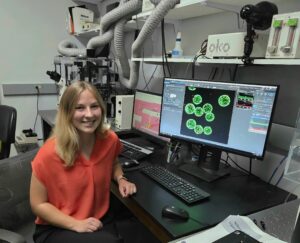
Spaceflight-associated neuro-ocular syndrome (SANS) is a major health concern for individuals who spend extended periods of time in low Earth orbit, particularly long-duration astronauts. This condition is characterized by increased intracranial pressure, retina structural changes, and visual impairment. Exposure to microgravity has been identified as a primary risk factor, yet the underlying cellular mechanisms are not fully understood. Microgravity is known to disrupt the biomechanical signaling in many human cell types, and comparable disruptions are associated with pathological changes in retinal pigmented epithelial (RPE) and potentially choroidal vascular endothelial (ChEC) cells in other ocular diseases.

We aim to characterize the impact of simulated microgravity on the gene expression of RPE and ChEC cells and investigate the role of mechanotransduction signaling in this response. Using cells cultured on microcarrier beads suspended within a rotating bioreactor, we simulate microgravity by balancing sedimentation and centrifugal forces. We will evaluate cells for changes in gene expression, viability, and function compared to Earth gravity. We can also assess the effects of introducing small-molecule inhibitors known to disrupt mechanotransduction, such as Rho Kinase Inhibitors, which have demonstrated therapeutic uses in ophthalmology.

This project aligns with the NASA Mission Directorates by addressing a physiological risk that affects human safety and performance during spaceflight. Space exploration is an important endeavor, but it can only be sustained if we uphold the health and safety of astronauts. By advancing our understanding of cellular responses to microgravity, this research will provide insight into countermeasures that support astronaut health and performance.
Brendyn Little – University of Iowa

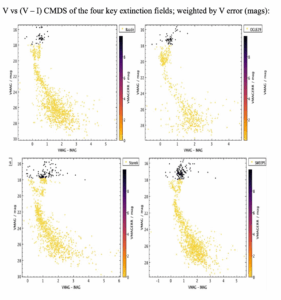
Galactic archaeology — the study of the structure and formation of the Milky Way — provides a snapshot of the kinematics, composition, and evolution of our galaxy, helping us understand the processes that take place in Milky Way-like galaxies at different stages. A key issue with this is our limited perspective of the Milky Way, making it extremely hard to study some regions such as the Galactic Bulge, Galactic Center, and spiral arms behind them.

In this project, I revisit “low extinction windows” in the Galactic Bulge previously studied by Thomas Brown (2009) via the WFC3 Galactic Bulge Treasury Program. I will compare the results of the program’s Hubble Space Telescope’s WFC3 data to newer data by cross matching it to databases such as Gaia’s EDR3. Additionally, we will use new stellar models such as Tim Morton’s isochrones (2015) and explore more recent studies of the Bulge if time permits. From this, I will create improved extinction maps to characterize the stellar populations of the Bulge. All of this will provide a deeper insight into the kinematics, composition, and evolution of both the Galactic Bulge and the Milky Way.
Braden Carne – University of Iowa

Eugene Parker first coined the existence of a “solar wind” in 1958, theorizing that the Sun’s corona emits a constant stream of charged particles as a plasma. Since then, heliophysicists have been working to describe the mechanisms, phenomena, and structures that occur due to the solar wind.
One of these structures is the critical point at which the corona transitions to becoming the solar wind, called the Alfvén surface (or Alfvén critical point), named after Hannes Alfvén. Parker Solar Probe (PSP), launched in 2018, was the first spacecraft to penetrate the Alfvén surface and obtain readings across the Alfvén surface and inside the corona, giving physicists a wealth of data to explore.

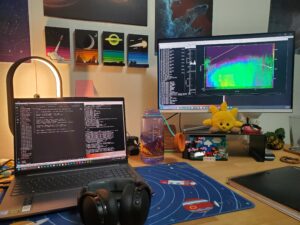
My research focuses on electron behavior across the critical point and if/how they deviate from expected behavior. I do this using results from PSP using the SWEAP (Solar Wind Electrons, Protons, and Alphas) instrument suite and performing statistical and numerical analyses and calculations.

Jack Brooks – Iowa State University

In gamma-ray astronomy, the ability to combine data from multiple observatories that sample different regions of the gamma-ray spectrum is crucial to understanding processes–such as particle acceleration and diffusion–that take place in and around astrophysical phenomena. Ground-based gamma-ray observatories therefore provide an important complement to NASA’s Fermi Gamma-Ray Space Telescope (FGST).

In particle astrophysics, extended maximum likelihood methods, which can be used to derive the fractional contributions as well as spatial and spectral parameters of multiple data components with different astrophysical origins, also provide a natural framework for combining data from multiple observatories. Such techniques are already the standard approach for analyzing data from the FGST. Our research seeks to address the problems that arise when applying the technique of binned extended maximum likelihoods to data procured for ground-based gamma-ray astronomy. These problems stem from the fact that gamma-ray astronomy data spaces are largely dominated not by gamma-rays, but by cosmic rays. The large uncertainties associated with Monte Carlo models of cosmic ray background in conjunction with the low uncertainties of gamma-ray models result in a data space comprising regions of high uncertainty and other regions of low uncertainty. A data space of this form introduces serious mathematical issues for present maximum likelihood methods. Our objective is to run a series of tests that emulate this problematic scenario in order to better understand the statistical considerations that must be made for maximum likelihood analysis of gamma-ray data.

Mallory Weber – University of Iowa

X-ray science can shed light on key physics, probing how black holes behave, how they influence galactic evolution, and how massive stars shape their environments through powerful winds. Observations at these wavelengths require sending technology above the Earth’s atmosphere, where the desired signals are not absorbed. This makes CubeSats and SmallSats important tools for conducting X-ray science, providing low cost access to space for focused experiments. However, these missions require efficient, moderately sized X-ray detectors at low costs in order to perform their target science. My group is examining the performance of commercial CMOS sensors for use in soft X-ray observations and their potential as low-cost alternatives to CCD sensors.

We have shown that the CMOS performance is on par with CCDs currently in use in several major spacecraft, and their readout rates and operable temperatures are more favorable. My research focuses on measuring the quantum efficiency (QE) of the CMOS sensor, which will inform us upon the sensitivity of the instrument. I will develop a test bed in a specialized vacuum chamber equipped with an X-ray source that will allow us to make preliminary measurements at different X-ray wavelengths to determine the QE. Additionally, we plan to eventually further these measurements during a test campaign at the Advanced Light Source, an X-ray synchrotron facility.