Describe what you did during your internship:
During this internship I participated in many fashions from my own project work to additional opportunities given to interns. For project work, my day-to-day included CAD modeling in CREO, using the MSFC Makerspace to 3d print and test parts, soldering circuit designs on protoboards, programming an Arduino UNO with the Arduino IDE, etc. Additional to PRIME, I spent plenty of time working on particle characterization which included running morphology as well as particle size distribution on AM powders and various regolith simulants. I also had the opportunity to take optical measurements on materials intended for flight under the Materials on International Space Station Experiment (MISSE) as well as on the passive side of Boeing’s Gateway docking station. There were also several tour opportunities such as to see Artemis hardware, the ISS Payload Ops Center & Lab Training Complex, and the National Center for Advanced Manufacturing (NCAM).
Did you achieve your goals?
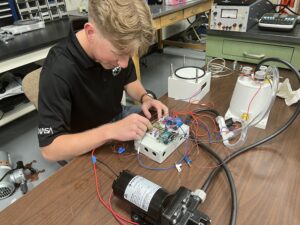
During this internship, all goals and objectives put in place were not just met but exceeded. Over the course of the 16-week session, a complete overhaul of the system was completed. Ultrasonic transducers were successfully reverse engineered from an off the shelf ultrasonic cleaning unit and integrated into PRIME. Additionally, structural design changes were made in order to ensure a watertight system and a circuit capable of automatic operation was designed and soldered utilizing a protoboard and Arduino Uno. At the conclusion of the rapid prototyping process, a functional ground prototype was assembled. This ground prototype was then used to give a successful demo, drawing heavy interest in the future of PRIME. Following this demo, the ground prototype was put through initial testing which resulted in successful cleaning of contaminants during each test run. With this prototype verifying proof of concept and jumping the technology readiness level (TRL) of the ground version of PRIME, efforts were commenced to make progress towards a flight capable capsule. This involved collaboration the lead Glovebox Integration engineer at MSFC as the end goal of PRIME is to be launched to the International Space Station (ISS) for extensive microgravity testing as a Microgravity Science Glovebox (MSG) experiment. Towards the end of this 16-week session, a paper was written on the current status and design of PRIME as well as future work for the flight model. This paper will be utilized by future PRIME manpower as project guidance. Beyond this, a poster was produced to be displayed inside building 4711 at MSFC.
Describe positive lessons learned:
One of the biggest lessons I learned during this session was how to handle the difference between life in academia and life in industry. There was an initial learning curve of not going home and spending the entire evening diving deeper into my work. A major item for me was beating imposter syndrome, I was intimidated by the idea of coming to MSFC and had my own doubts. This internship showed me what I can do and has boosted my confidence as a student and engineer.
Describe negative lessons learned:
My one major takeaway as something to adjust to is implementing patience. Many situations have occurred where processes with NASA take longer then desired and caused unwanted downtime.
What was the impact of this internship?
This internship has opened the door to vast opportunities within NASA. Getting a taste of what working for NASA is like has inspired me to stay on this path and come back for an internship this summer, along with making my way to working for NASA full-time following graduation.

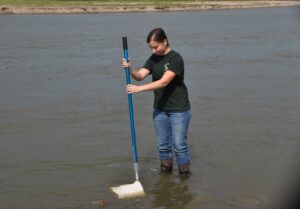 phates. I will also use a biotic index to determine the diversity of indicator species of macroinvertebrates to consider when determining overall ecosystem health. My main goal with this project is to look into the effects of neighboring land use on aquatic ecosystem health. Especially here in Iowa, where agriculture plays a significant role in the environment, I would like to use the data collected from this study to see how much of a role agricultural runoff has on waterways versus, for example, urban runoff. Over the initial fall semester, I intend to take several water samples and biotic index readings across these designated locations to see how they change over the span of a few months. I believe this will be particularly insightful, considering that some of this project will take place throughout the harvest season when additional agricultural runoff will be present. This project aligns with the Science Mission Directorate. This mission directorate’s goal of helping to protect our planet and better understand it directly relates to my project’s goals, which will help provide useful data regarding the impact of land usage on aquatic ecosystem health.
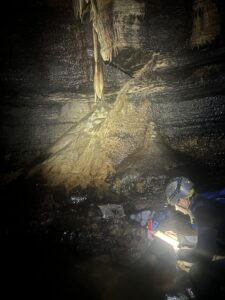 The Coldwater Water Analysis project involves collecting and analyzing water samples taken from Coldwater Creek and from the diverging branch that runs within Coldwater Cave. Over the summer months, samples are being taken from five sites from the surface stream and thirteen sites within Coldwater Cave. The samples are being used to compare the water quality of the surface stream before and after the surface and subterranean streams reunite at the Coldwater State Preserve. The main goal of the project is to calculate the Water Quality Index of the stream. The saturation index of the water flowing within the cave will also be calculated at the end of the summer to understand whether the ground waters and tributary streams are actively dissolving pre-existing carbonates or if the waters are actively depositing fresh carbonates. The data being collected provides insights for the water mixing models in caves and corresponding streams that could provide insights into the interstellar lakes of the icy moons of the gas giants of the solar system. Moving into the fall, we plan to expand the sampling to other streams within the Coldwater Caves watershed and begin comparing that data to water collected from similar karst systems such as Wind Cave National Park and Mystery Cave State Park.

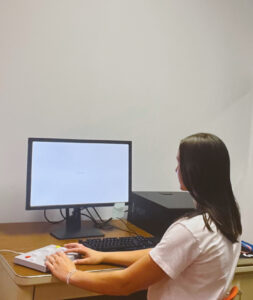 My current academic research project is based in psychology, specifically focusing on motivation and attention. Throughout my behavioral study, I will focus on how motivation can have an impact on someone’s attentional breadth, or the amount that someone is attuned to global vs specific features of an object or situation. By doing this, I hope to clear up disparities in existing work on the effect of motivation on attentional breadth and produce a literature review of the current experiments that pertain to the subject. Motivation is key to understand in the discipline of psychology, for it affects how willing people are to put their time, effort, and resources into certain projects or ideas. Additionally, if motivation plays a role in attentional breadth, this could inform how people’s understanding of certain ideas can be manipulated by their level of motivation at a given time.


 Describe what you did during your internship:
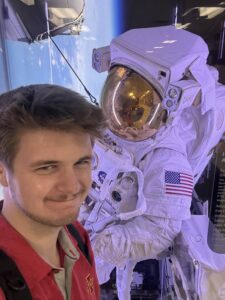

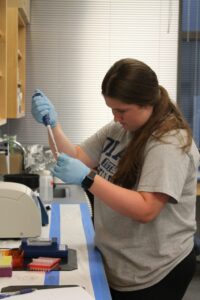 A big concern for the health of astronauts and space crews is exposure to radiation and NASA lists “Risk of Radiation Carcinogenesis from Space Radiation” as one of its top research priorities. On Earth, we are protected from most space radiation by the atmosphere, but radiation increasingly affects those outside of Earth’s atmosphere and beyond low Earth orbit. Ionizing radiation damages DNA most commonly via phosphodiester backbone breakage. Humans can repair these damages, but prolonged exposure can lead to genomic instability and cancer. Thus, it is important to understand and monitor genome stability of astronauts during space travel. Therefore, our main goal is to develop biomarkers of radiation-induced DNA damage for monitoring genome stability of astronauts during and after space travel, thus contributing to safer space exploration. Previously, we have analyzed signal transduction DNA damage repair pathway genes in human mammary tumor cell lines. However, skin cancer is also a major concern due to radiation exposure, and understanding DNA repair pathways in skin cancer is equally important. Therefore, using the human skin cancer cell line HTB-72 and doxorubicin as a radiomimetic model, we will investigate how the oncoprotein BRAF responds to radiation-induced DNA damage. The data produced from this project will help us understand differences between the development of breast cancer and skin cancer.
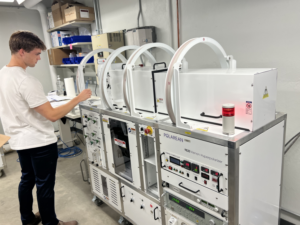 Medical imaging serves a crucial role in establishing diagnosis, determining severity, monitoring progression, and uncovering the pathophysiology associated with many diseases. This research, led by Dr. Sean Fain, explores novel applications of hyperpolarized (HP) 129Xe magnetic resonance imaging (MRI) in populations including those suffering from Long Covid, cystic fibrosis, interstitial lung disease, and radiation-induced pulmonary changes associated with radiation therapy. This technique differs from standard imaging practices today while measuring lung function more directly than conventional pulmonary tests delivering quantitative measures of ventilation, perfusion, and gas exchange of the lungs. After more research, these novel biomarkers could possibly guide adjustments to treatment and deployment of potential therapies to improve outcomes.